Quantum Computing
TL;DR: Traditional computers work with bits, 0 and 1. Quantum Computers work with "qubits".
Traditional computers work with bits, 0 and 1. Those numbers represent the electric current that flows through a cable, 1 represents electricity, 0 represents void. The bit is the smallest unit of data in a computer.
In Quantum Computing, the smallest unit of data is a Qubit.
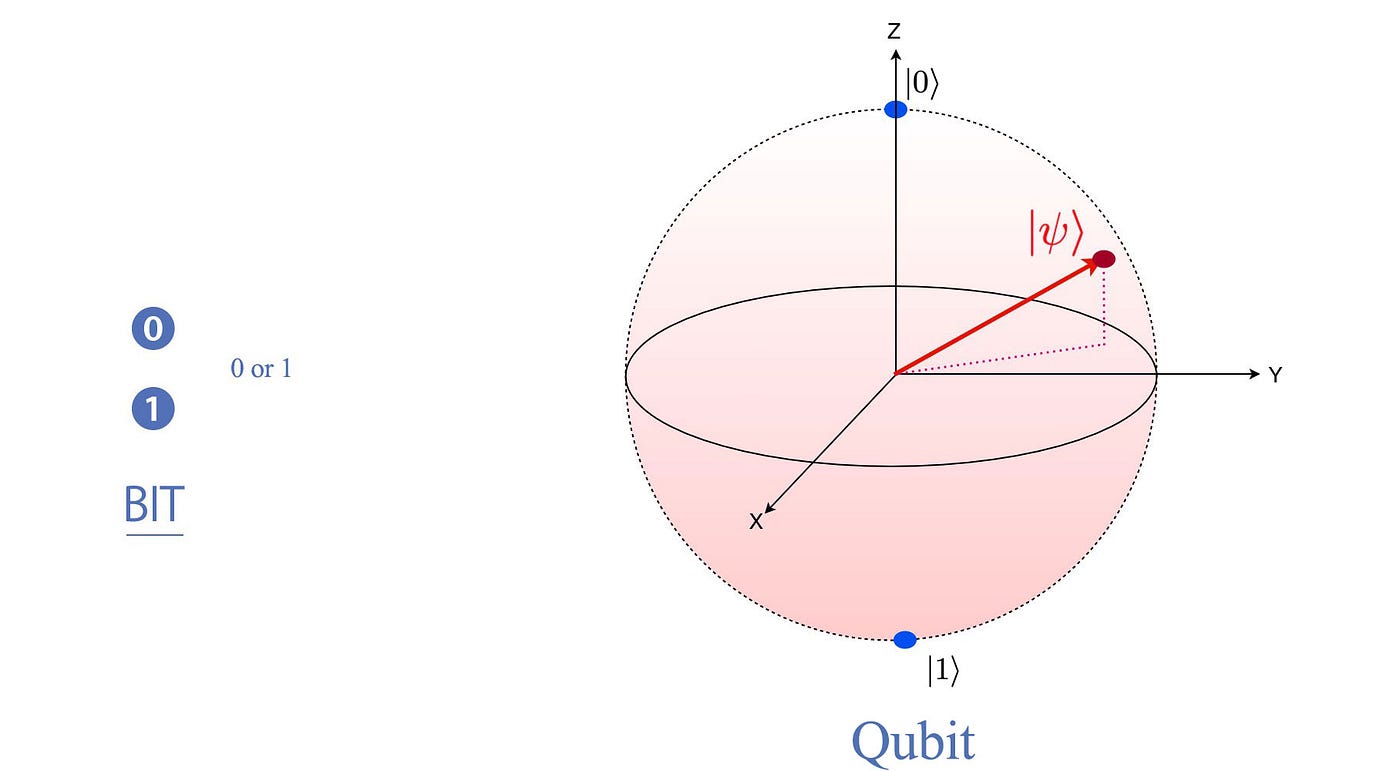
Taken from How to build a Quantum Computer with Superconducting Circuit?
A Qubit is a concept that was born from quantum physics.
The Relation Between Quantum Computing and Quantum Physics
Traditional physics establish that things either exist or don't, things are or they aren't. An atom is the smallest unit of matter and it's composed by protons, electrons, and neutrons. As atoms are incredibly small, it's very hard to understand what are protons, electrons, and neutrons made off, inside of them there are energy fluctuations, other particles, etc. and these enter to the realm of quantum physics.
One of the main principles of quantum physics is that it cannot be observed. As quantum physics is always changing, at the moment when it becomes observed it's like a filter crashes the function and it becomes tradictional physics.
Quantum Computing applies the principles of quantum physics, instead of using absolute numbers, like 0 and 1, it uses percentages and approximations.
A Qubit can still be 0 and 1, but also all the values that are in between.
Multiple Qubits interact with each other with something that is called interference to determine the probability of a problem.
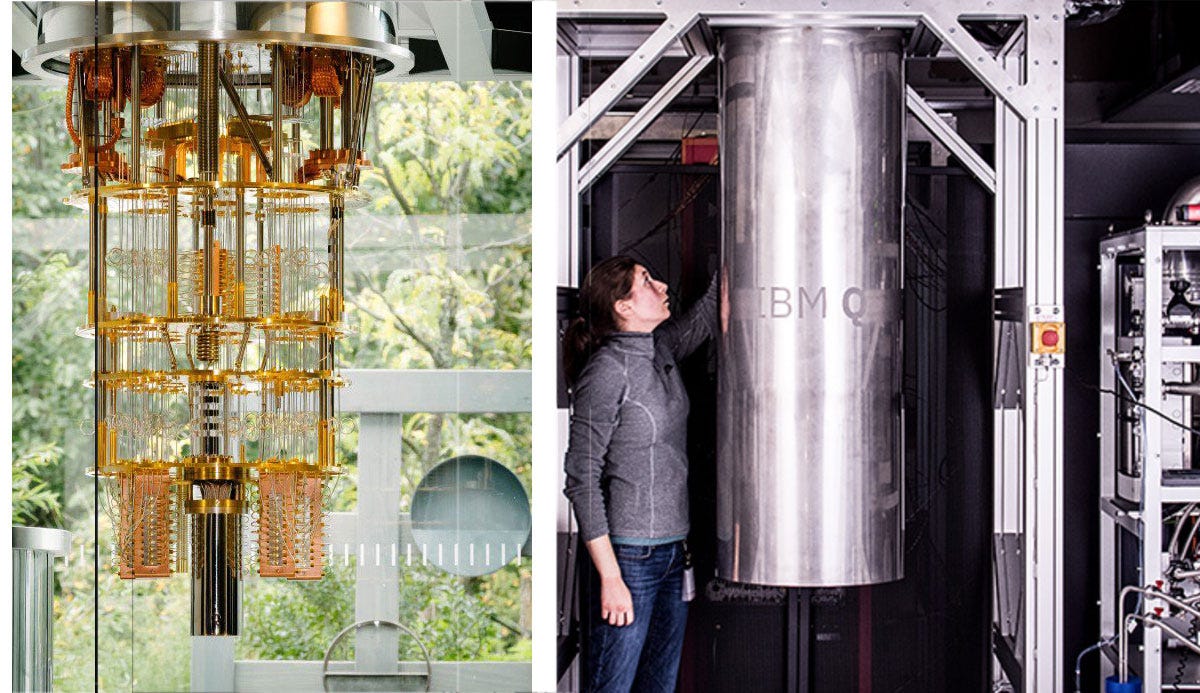
Taken from How to build a Quantum Computer with Superconducting Circuit?
In order for Quantum Computers to work, they need to be completly isolated from external factors that can cause interference: light, other atoms, heat, etc. Therefore, these computers are wrapped by a huge case that creates a cold and void environment inside of it.
The Problem With Traditional Computers
One of the main problems with traditional computers is that processors are reaching the limit on how small they can be. A processor is made of transistors. A transistor is a device that can make elictricity pass througth it (0 or 1). These devices can be used to create logic gates (and, or, xor, etc.) and then they become structures to create variables, fors, conditionals, objects, etc.
The smaller transistors we have, the closer they can be located; and therefore, the quicker they become to respond. The more number of transistors, the more electricity they use; and therefore, they heat up more.
Transistors size is close to get to the atomic level and, for this reason, there is going to be a point in time were the limit of this architecture is going to be reached.
This is when Quantum Computing comes into action. A Qubit can be defined as bitsbits. For example, with two bits we can have the next values 00, 01, 10, and 11. With a Qubit we can have all those values at the same time. For example, if we have 64 bits, the same amount of Qubits will give us 6464 possible values.
The 2 + 2 Problem
How do traditional computers calculate the result of 2 + 2? They take that expression and converts it into it's smallest definition, in this case, 1 + 1 + 1 + 1 and then, they can calculate that the answer is 4.
How will a Quantum Computer solve 2 + 2? They take that expression and then "mounts it" in a probabilistic system where Qubits start something called interference that is how the Qubits will select the answer that has the higher probability to be correct. As an example of this can be, imagine that to solve 2 + 2 the probabilistic system created looks like this:
| Possible Answer | Probability |
|---|---|
| 1? | ~5% |
| 2? | ~15% |
| 3? | ~25% |
| 4? | ~90% |
| 5? | ~35% |
| 512? | ~0.1% |
In this case, the quantum computer will inform that the possible answer can be 4 becuase it has the higher probability to be correct. This process takes more time than with traditional computers, and they create those probabilities with the interference created between the Qubits.
For cases like this, Quantum Computers seem to be useless vs traditional computers. However, there are some specific math problems that are almost impossible for traditional computers to answer. For example, prime numbers, divisibility of a number, etc. These problems are really hard for a traditional computer but can be "easily solved" by Quantum Computers.
The Problem of the Divisibility of a Number
How will traditional computers solve the problem: which are all the possible divisors of 91? Probably, a cicle will be created to verify all the possible answers from i = 2 to i = 90. This solution can be improved but still will be very expensive to get the results. The larger the target number, the harder the problem becomes.
Modern Criptography uses this problem to generate keys. A very large number is selected and the divisors of it are pre-calculated and they become the keys. Traditional computers can take lots of years to calculate these numbers.
How Quantum Computers will solve the same problem? Lets imagine that they create a probabilistic system that looks like this:
| Possible Answer | Probability |
|---|---|
| 1? | ~5% |
| 2? | ~15% |
| 5? | ~25% |
| 7? | ~90% |
| 13? | ~90% |
| 40? | ~33% |
| 45? | ~73% |
| 100? | ~0.1% |
Quantum Computers will inform about the probabilities and these can be easily tested by the users. For very large numbers, quantum computers overcome traditional computers in execution time. This puts into danger some of the current criptography and security methods used.
For the majority of problems, Quantum Computers are not the best option, but they can be used for problems that can be answered with probabilities. This opens a new world of possibilities to solve problems, for example, criptography could now implement something like "quantum keys" that can be totally random and only achivable with Quantum calculations.
Quantum Computers can be also used for other areas, for example, simulation. They can be used to create molecules simulation like DNA, protein chains, etc. this will improve medical developments.
Common Misconceptions
- Quantum teletransportation does not exist. It's mathematically possible, but impossible to execute.
- Quantum does not mean that is faster than the speed of light.
- Quantum is not something ethereal.